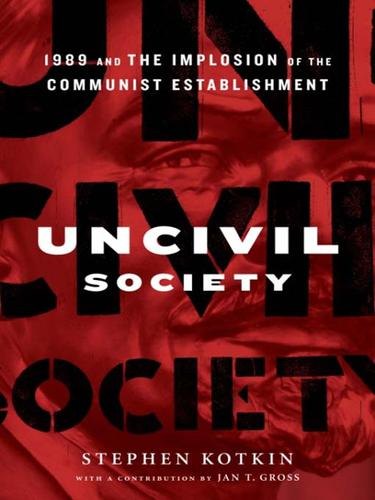
Uncivil Society
Stephen Kotkin
1989 and the Implosion of the Communist Establishment
Work in progress: these are rough notes toward an essay I’ll finish later.
Back in the 1970s, most commentators thought that the capitalist West, not communism, was nearing collapse, and even in the second half of the 1980s, Communist systems seemed not doomed but uncertain. Unexpectedly, however, 1989 turned out to be an annus mirabilis, producing revolutions in Eastern Europe that sparked repercussions around the globe, from apartheid South Africa to one-party Mexico.
It’s funny to think about now. But I was reminded of this preface I read in a book published in 1975 about technology in the middle ages. It bizarrely ends with a pronouncement that unlike economic crises throughout history, the one America was suffering in the 70s (when the book was written) will have no end.
Ken Rogoff talks about this phenomenon as well, where over the last century, every single competitor to America and the dollar has lost significant share. In Japan in the 80s, European Union in the 2000s. I don’t know what the lesson is for America today. Dismiss the hyperbole of how our society of regulations and lawyers can’t compete against an innovative and industrial China? Is that like a man who has won a coin toss 4 times in a row explaining why this means he’s guaranteed to win the 5th?
Kotkin’s main point is that the Soviet Union collapsed not because of heroic revolutionaries or organized civil society - rather it was the Moscow government intentionally forfeiting its crackdown backstop in order to encourage reform at the periphery.
The 1989 revolutions did not happen because of a broad freedom drive or an establishment self-enrichment grab. The cave-in was unintended, precipitated by Gorbachev’s unilateral removal of the Soviet backstop, a move that had been intended to goad socialist-bloc countries to reform themselves. In other words, Gorbachev was looking to galvanize the reform-minded Gorbachevs of Eastern Europe. There was only one flaw in this approach: there were no East European Gorbachevs.
in 1989 “civil society” could not have shattered Soviet-style socialism for the simple reason that civil society in Eastern Europe did not then actually exist. The mostly small groups of dissidents, however important morally, could not have constituted any kind of society. On the contrary, it was the establishment—the “uncivil society”—that brought down its own system.
Establishments that could collectivize a peasantry and nationalize an entire country subsequently found themselves unable to take the slightest corrective actions when something failed to go according to plan.
Why actually is that?
Incompetence in Communist systems was therefore structural. To remove any possible threats of being unseated, and to increase the bonds of dependency, officials often preferred appointing the less able to be their direct subordinates, something that was repeated all the way down the hierarchy.
The foreign policy considerations of the Soviet Union seem quite different from China today. Despite both of them having a Leninist system. It does not seem important to China that its allies share its system of government. But the 1956 crackdown on Hungary and the 1968 crackdown on Czechoslovakia were motivated because the Soviets felt that if any country in the Warsaw Pact did go capitalist or democratic, it would actually discredit their whole regime.